FintechZoom.com Nasdaq: What Is It and How Can You Track the Stock Market?
Keeping track of stock market movements can feel confusing, especially when prices change quickly and financial news appears from multiple sources. Investors need clear information to understand market trends, follow technology companies, and evaluate investment opportunities. fintechzoom.com nasdaq is a search term associated with financial coverage of Nasdaq markets on FintechZoom. Understanding what this coverage offers, how Nasdaq indexes work, and where to verify market information can help readers make better-informed financial decisions.
What Is FintechZoom.com Nasdaq?
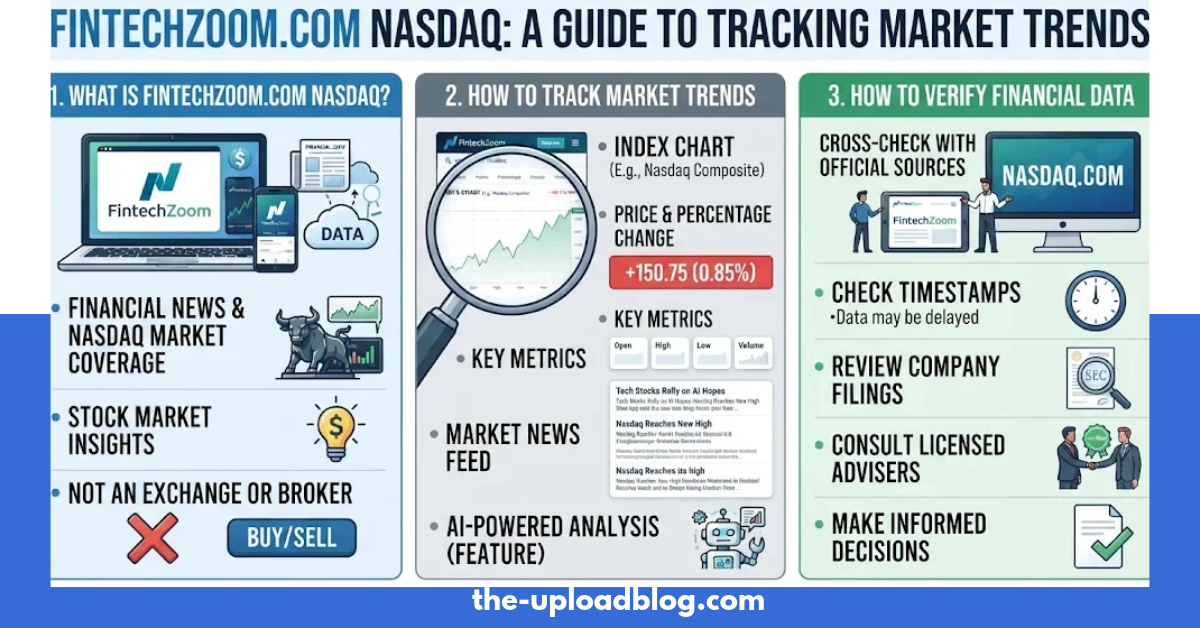
The term fintechzoom.com nasdaq refers to Nasdaq-related market information and financial coverage that readers look for on the FintechZoom website.
FintechZoom is a financial information and media website that covers different areas of the financial industry. Its subject areas include stock markets, cryptocurrencies, commodities, business developments, and economic news.
Nasdaq is particularly important because it includes many well-known technology companies and other major businesses. Readers interested in technology shares often follow Nasdaq-related news to understand how these companies perform.
It is important to understand one distinction: FintechZoom is not the Nasdaq Stock Market. It is a separate financial information website, while Nasdaq operates financial markets and publishes official index information.
What readers generally look for includes:
- Nasdaq market movements and daily performance.
- Technology stock news and company developments.
- Nasdaq Composite and Nasdaq-100 information.
- Historical market trends and stock charts.
- Financial analysis and investment education.
- Information about market volatility and trading activity.
How Does FintechZoom.com Nasdaq Coverage Help Readers?
Financial information becomes more useful when readers can understand what is happening in the market and why it matters.
The fintechzoom.com nasdaq topic can help readers discover market-related articles, financial explanations, and information about companies listed on Nasdaq.
Rather than looking at stock prices without context, readers should examine several factors before interpreting a market movement.
For example, a technology company’s share price might increase after a strong earnings announcement. Another company’s stock might fall because of disappointing revenue, changing interest rates, or weaker market expectations.
Understanding these connections helps readers develop a broader view of financial markets.
Key benefits of following Nasdaq-related financial coverage
- Market awareness: Follow developments affecting major publicly traded companies.
- Technology sector insights: Understand developments involving software, semiconductors, artificial intelligence, and other industries.
- Financial education: Learn common investment and market terminology.
- Trend monitoring: Compare market movements over different periods.
- Investment preparation: Identify information that deserves further research.
However, financial articles should support research rather than replace official market information or independent investment analysis.
Understanding the Nasdaq Stock Market
Nasdaq is one of the major stock exchange operators in the United States.
The Nasdaq Stock Market provides a marketplace where eligible companies can list their shares and investors can trade securities through brokers.
It is particularly associated with technology and growth-oriented businesses, although its listed companies operate across many industries.
Nasdaq also provides financial indexes that measure the performance of selected groups of companies.
Three important terms deserve attention:
- Nasdaq Stock Market: The exchange where listed securities trade.
- Nasdaq Composite: A broad index measuring eligible common stocks listed on Nasdaq.
- Nasdaq-100: An index tracking 100 of the largest non-financial companies listed on Nasdaq, subject to its index rules.
These terms are related, but they do not mean the same thing.
Nasdaq Composite vs. Nasdaq-100: What Is the Difference?
One common mistake among beginners is treating the Nasdaq Composite and Nasdaq-100 as identical indexes.
Both provide information about Nasdaq-listed companies, but their coverage and construction differ.
The Nasdaq Composite covers a much broader group of eligible companies. The Nasdaq-100 focuses on 100 of the largest domestic and international non-financial companies listed on the exchange.
Understanding this difference helps readers interpret financial headlines and market charts correctly.
| Feature | Nasdaq Composite | Nasdaq-100 |
| Main purpose | Measures a broad range of Nasdaq-listed stocks | Tracks 100 of the largest non-financial Nasdaq-listed companies |
| Coverage | Thousands of eligible companies | 100 companies |
| Financial companies | Eligible securities may include financial companies | Excludes financial companies |
| Weighting | Market capitalization | Modified market capitalization |
| Main use | Understanding broader Nasdaq market performance | Following large-cap growth and major companies |
| Common ticker | COMP | NDX |
| Investment relevance | Broad market benchmark | Benchmark for several investment products |
| Market exposure | Large, medium, and smaller companies | Primarily large companies |
| Updates | Reflects changes in eligible listings | Quarterly rebalancing and annual reconstitution |
Which Companies Influence Nasdaq Performance?
Large companies can have a significant influence on Nasdaq index movements because index weighting considers company market capitalization.
Technology companies receive considerable attention because many major technology businesses are listed on Nasdaq.
Some widely followed companies include:
- Apple – Consumer electronics, software, and digital services.
- Microsoft – Cloud computing, software, and artificial intelligence.
- NVIDIA – Graphics processors and AI computing hardware.
- Amazon – E-commerce and cloud computing.
- Alphabet – Google, digital advertising, and AI technology.
- Meta Platforms – Social media, digital advertising, and virtual reality.
- Broadcom – Semiconductor and infrastructure technology.
These businesses operate in different areas, but their financial performance can influence investor sentiment and broader market trends.
Readers following fintechzoom.com nasdaq should remember that a company’s share price movement does not automatically represent the performance of the entire index.
How to Read Nasdaq Stock Market Charts
Stock charts help readers understand how prices change over time. They display historical movements and provide a visual way to examine market behavior.
A chart becomes more useful when readers understand its basic elements.
Important chart elements
1. Opening price
The opening price represents the price at which a security begins regular trading for a particular session.
2. Closing price
The closing price represents the final regular-session trading price, subject to applicable market corrections and reporting conventions.
3. High and low prices
These figures show the highest and lowest prices recorded during a selected trading period.
4. Trading volume
Volume measures how many shares were traded during a specific period. Higher volume can indicate increased trading activity.
5. Percentage change
This figure shows how much a stock or index has increased or decreased compared with a reference value.
6. Moving averages
Moving averages calculate average prices over selected periods. Traders use them to examine broader price trends and reduce the impact of short-term fluctuations.
How to interpret a stock chart
Consider this simple example:
| Market information | Example value | What it means |
| Previous close | $100 | Last session’s closing price |
| Opening price | $102 | Price at the start of the session |
| Current price | $105 | Latest displayed price |
| Daily high | $107 | Highest recorded price |
| Daily low | $99 | Lowest recorded price |
| Trading volume | 2 million | Shares traded during the period |
| Price change | +5% | Increase compared with previous close |
These are illustrative figures, not live market quotations.
When examining fintechzoom.com nasdaq market information, compare the displayed period, timestamp, ticker symbol, and data source before interpreting a chart.
What Factors Affect Nasdaq Market Movements?
Nasdaq prices change because investors continually respond to financial information, company announcements, economic developments, and expectations.
Several important factors can influence daily market performance.
Company earnings reports
Quarterly earnings reports provide information about revenue, profits, operating expenses, and future expectations.
Strong financial results may improve investor confidence, while disappointing results can put pressure on share prices.
Interest rates
Interest rates influence borrowing costs, business expansion, consumer spending, and investment decisions.
Higher interest rates can put pressure on growth-oriented company valuations because investors may reassess the value of expected future earnings.
Inflation reports
Inflation affects purchasing power, business expenses, and central bank decisions.
Investors regularly monitor inflation reports because unexpected changes can influence market expectations.
Artificial intelligence developments
AI-related businesses have received significant attention from investors.
Developments in AI software, data centers, cloud infrastructure, and semiconductor technology can influence expectations about future business growth.
Global economic conditions
International trade, geopolitical developments, supply-chain disruptions, and currency movements can affect publicly traded businesses.
Companies operating internationally may experience changes in revenue and operating costs because of these developments.
Investor sentiment
Market prices also reflect expectations and emotions.
Positive news can encourage buying activity, while uncertainty can increase selling pressure and market volatility.
How to Use FintechZoom.com Nasdaq for Market Research
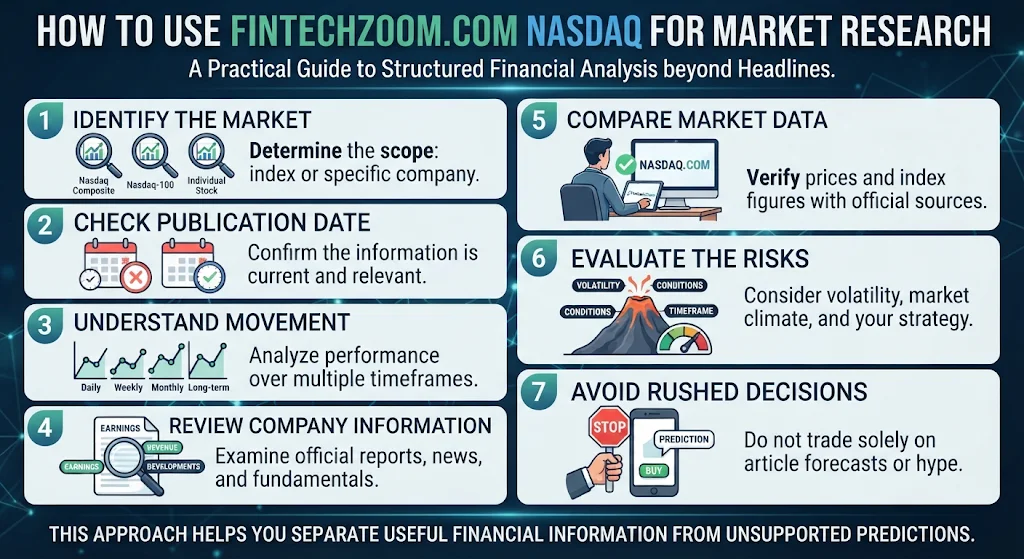
Readers looking for fintechzoom.com nasdaq information should follow a structured research process instead of relying on a single headline or chart.
The following steps provide a practical starting point.
- Identify the market: Determine whether the information concerns the Nasdaq Composite, Nasdaq-100, or an individual stock.
- Check the publication date: Confirm that the article or market update is recent enough for your research.
- Understand the movement: Look at daily, weekly, monthly, and longer-term performance.
- Review company information: Examine earnings reports, revenue, business developments, and official announcements.
- Compare market data: Verify important prices and index figures through Nasdaq’s official resources.
- Evaluate the risks: Consider volatility, market conditions, and your investment timeframe.
- Avoid rushed decisions: Do not buy or sell shares simply because a financial article predicts a price movement.
This approach helps readers separate useful financial information from unsupported predictions.
How to Verify Nasdaq Prices and Financial Information
Accuracy is essential when researching financial markets.
A third-party financial website may provide useful market summaries, but readers should not automatically assume that every displayed figure represents an exchange-direct, real-time quotation.
For fintechzoom.com nasdaq research, use the following verification methods:
- Visit Nasdaq’s official market activity pages.
- Check the official Nasdaq Composite and Nasdaq-100 index pages.
- Review company investor relations websites.
- Read official earnings announcements.
- Examine regulatory filings through the SEC’s EDGAR database.
- Compare timestamps and trading sessions.
- Check whether the information is delayed or updated in real time.
Reliable sources for financial verification
| Source | Information available | Why it matters |
| Nasdaq Market Activity | Market information and trading activity | Official exchange-related market resources |
| Nasdaq Global Indexes | Index values and methodologies | Helps verify index information |
| SEC EDGAR | Company filings and disclosures | Provides regulatory company information |
| Investor.gov | Investment education and risk information | Helps investors understand financial products |
These sources are particularly useful when a market figure could influence an investment decision.
Is FintechZoom.com Nasdaq Suitable for Beginners?
Beginners can use financial news websites to become familiar with stock market terminology and financial developments.
The fintechzoom.com nasdaq topic may be useful for discovering articles about market movements, company performance, and technology-related businesses.
However, beginners should understand basic financial concepts before using market information to make investment decisions.
Start by learning:
- What stocks and stock exchanges are.
- How market capitalization works.
- What an index represents.
- How stock prices change.
- Why companies publish earnings reports.
- What trading volume indicates.
- How diversification can reduce investment concentration.
- Why past performance does not guarantee future returns.
The U.S. Securities and Exchange Commission explains that index funds track market indexes but carry investment risks, including tracking differences and losses in the underlying securities.
A beginner should prioritize financial education, careful research, and risk awareness instead of chasing quick profits.
Advantages and Limitations of FintechZoom.com Nasdaq
Understanding the strengths and limitations of financial websites helps readers use their information more effectively.
The fintechzoom.com nasdaq search topic offers an opportunity to explore market-related information, but every financial platform has limitations.
Advantages
- Convenient research: Readers can explore different financial topics in one place.
- Market awareness: Financial articles can help readers follow important developments.
- Technology coverage: Readers can explore companies operating in the technology industry.
- Educational value: Financial explanations can help beginners understand market terminology.
- Trend discovery: Market articles can introduce readers to developing financial trends.
Limitations
- Data verification: Third-party figures should be checked against official sources.
- Market delays: Some displayed prices may not reflect the latest trading activity.
- Prediction risks: Financial forecasts cannot guarantee future market performance.
- Information quality: Readers should evaluate the sources and evidence behind published claims.
- Investment responsibility: Reading market information does not replace independent financial research.
The best approach is to use FintechZoom as a potential starting point for research while relying on authoritative sources to verify important information.
The Role of Technology in Nasdaq’s Future
Technology continues to influence the development of financial markets.
Artificial intelligence, cloud computing, cybersecurity, semiconductor manufacturing, and financial automation are changing how companies operate and compete.
These developments also influence investor expectations.
Artificial intelligence
AI is becoming increasingly important across business operations. Companies are investing in AI infrastructure, advanced computing systems, and automated services.
Semiconductor innovation
Semiconductors support smartphones, computers, data centers, and AI applications. Demand for advanced chips can influence the financial outlook of semiconductor businesses.
Cloud computing
Businesses increasingly depend on cloud infrastructure to store information, operate applications, and manage digital services.
Financial technology
Financial technology companies are developing digital payment systems, automated financial services, and new ways to manage financial information.
For readers exploring fintechzoom.com nasdaq, understanding these industries can provide useful context when following technology-related market developments.
However, technological progress does not guarantee higher stock prices. Company valuations, competition, financial results, and economic conditions remain important.
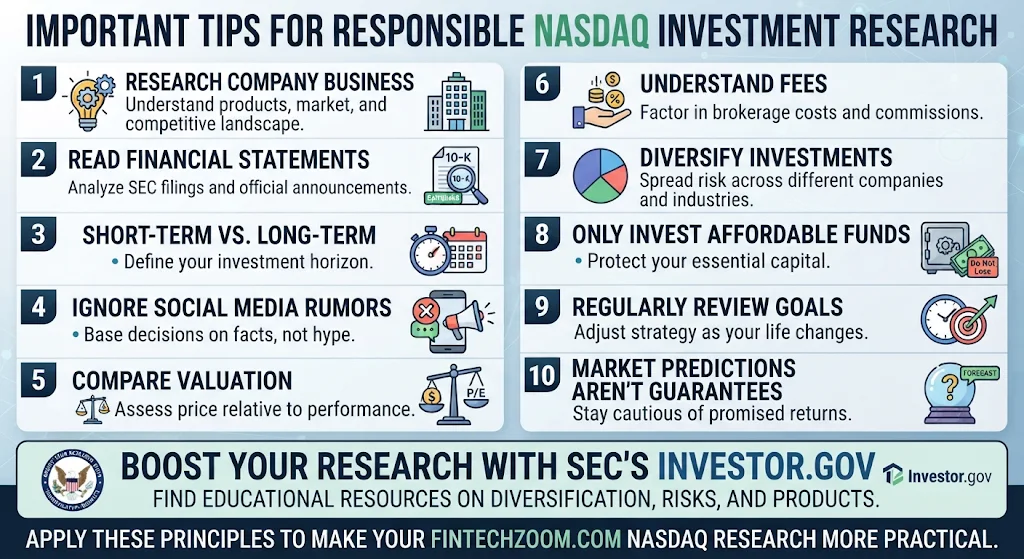
Important Tips for Responsible Nasdaq Investment Research
Following the market is only one part of investment research. Readers also need a practical approach to managing financial risk.
Here are useful habits to develop:
- Research a company’s business before considering its stock.
- Read official financial statements and earnings announcements.
- Understand the difference between short-term trading and long-term investing.
- Avoid making decisions based on social media rumors.
- Compare company valuations with financial performance.
- Understand brokerage fees and other investment costs.
- Diversify investments instead of concentrating everything in one company.
- Never invest money you cannot afford to lose.
- Review your investment goals regularly.
- Remember that market predictions are not guaranteed outcomes.
The SEC’s Investor.gov provides educational information about diversification, investment products, and financial risks.
These principles make fintechzoom.com nasdaq research more practical by encouraging readers to look beyond daily price movements.
Is FintechZoom.com Nasdaq an Official Financial Market Service?
No. FintechZoom and Nasdaq are separate entities.
FintechZoom publishes financial information and market-related content, while Nasdaq operates securities markets and maintains official financial indexes.
This distinction matters because readers should know whether they are viewing an independent financial article or information directly published by the organization responsible for an index.
For official index information, Nasdaq’s website provides descriptions, historical information, and methodology documents.
For company disclosures, the SEC’s EDGAR database provides access to regulatory filings.
Readers should also avoid confusing a financial website’s market coverage with brokerage services. A financial information website is not automatically a place where users can execute stock trades.
Why Should Readers Follow Nasdaq Market Trends?
Nasdaq market trends provide useful information about investor expectations, company performance, and developments across different industries.
Following these trends can help readers understand how economic changes influence publicly traded businesses.
For example, rising semiconductor demand may attract attention to chip manufacturers, while changes in interest rates can influence growth-oriented stocks.
The fintechzoom.com nasdaq topic is relevant to readers who want to explore these developments and understand the broader financial market.
A consistent research routine should include:
- Checking major index movements.
- Following important company announcements.
- Reviewing economic reports.
- Comparing historical performance.
- Understanding market risks.
- Verifying information through primary sources.
Combining these habits creates a more informed approach to financial research.
Frequently Asked Questions
What is fintechzoom.com nasdaq?
Fintechzoom.com nasdaq refers to Nasdaq-related financial coverage that readers search for on FintechZoom. It helps readers explore market news, stock information, technology companies, and financial developments. It is not a separate stock or official Nasdaq service.
Is FintechZoom.com affiliated with Nasdaq?
No. FintechZoom is a separate financial information website. Nasdaq is an independent exchange operator that manages financial markets and publishes official index information.
Can I track Nasdaq stock prices through FintechZoom?
Readers can look for Nasdaq-related market information through FintechZoom. However, they should check the displayed timestamp, data provider, and possible delays before relying on any quotation. Nasdaq’s official website is a suitable source for verifying index information.
What is the difference between Nasdaq Composite and Nasdaq-100?
The Nasdaq Composite tracks thousands of eligible securities listed on Nasdaq. The Nasdaq-100 tracks 100 of the largest non-financial companies listed on the exchange. Both measure market performance but follow different eligibility and weighting rules.
Is FintechZoom.com Nasdaq useful for beginner investors?
Yes, it can serve as a starting point for exploring financial news and market-related topics. Beginners should also study investment basics, understand financial risks, and verify important information through official sources before making investment decisions.
Can I buy Nasdaq stocks directly through FintechZoom?
FintechZoom’s financial coverage should not be confused with brokerage services. Investors generally purchase Nasdaq-listed shares through a licensed broker that provides access to the relevant securities market. Always verify a broker’s regulatory status before opening an account.
Conclusion
Understanding fintechzoom.com nasdaq can help readers explore financial news, technology companies, stock market developments, and major Nasdaq indexes. However, successful financial research requires more than following headlines or checking stock charts. Readers should understand the difference between the Nasdaq Composite and Nasdaq-100, examine company performance, and verify important market figures through official sources. Use financial information responsibly, continue learning about investment risks, and build research habits that support informed decisions.